


Introduction
In today’s competitive digital landscape, businesses constantly face a critical question: Should you invest in SEO or Paid Advertising to achieve the best return on investment (ROI)?
As we move through 2026, the answer is no longer black and white. Both strategies have evolved significantly with the rise of AI, changing search behavior, and increasing competition. Understanding how each channel performs—and when to use them—is essential for sustainable growth.
This article provides a professional, data-driven comparison of SEO and Paid Ads to help you make the right strategic decision.
Understanding SEO (Search Engine Optimization)
SEO is the process of optimizing a website to rank organically on search engines. It focuses on improving visibility without paying for each click.
Key Characteristics:
- Long-term traffic acquisition
- Cost-efficient over time
- Builds brand credibility and authority
- Compounding growth effect
SEO is often considered a digital asset because once rankings are achieved, traffic continues with minimal incremental cost.
Understanding Paid Advertising (PPC)
Paid Advertising, commonly known as Pay-Per-Click (PPC), involves paying platforms like Google or social media networks to display your ads to targeted users.
Key Characteristics:
- Immediate visibility and traffic
- Precise audience targeting
- Scalable with budget
- Full control over campaigns
Unlike SEO, Paid Ads function as a direct traffic driver—results are immediate but stop when spending ends.
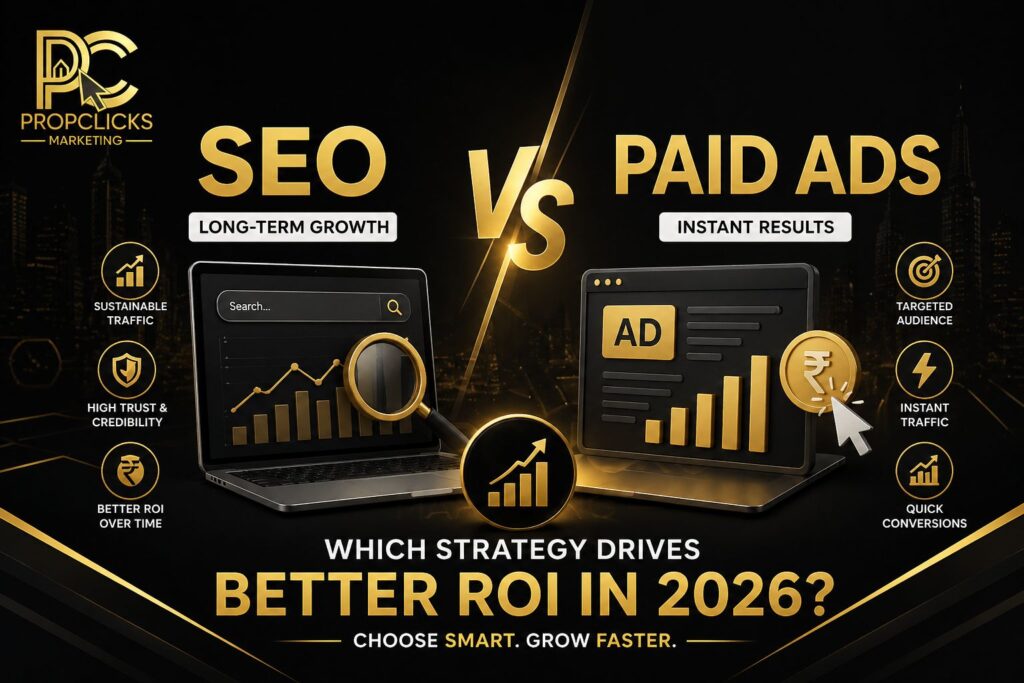
SEO vs Paid Ads: ROI Comparison in 2026
| Factor | SEO | Paid Ads |
|---|---|---|
| Time to Results | Medium to Long-Term | Immediate |
| Cost Structure | Upfront + Low ongoing | Continuous spend |
| ROI Potential | High (compounding) | Moderate (linear) |
| Traffic Sustainability | Long-lasting | Stops with budget |
| Trust & Credibility | High | Medium |
Key Insight:
SEO typically delivers higher ROI over time, while Paid Ads provide faster short-term returns.
Why SEO Delivers Stronger Long-Term ROI
1. Compounding Returns
SEO content continues to attract traffic long after it is published, creating a snowball effect in visibility and leads.
2. Lower Customer Acquisition Cost
Without paying per click, businesses significantly reduce long-term acquisition costs compared to paid campaigns.
3. Higher User Trust
Users are more likely to trust organic results, leading to better engagement and conversion rates.
4. Alignment with AI-Driven Search
Search engines increasingly prioritize high-quality, authoritative content—making SEO more valuable in 2026 than ever before.
Where Paid Ads Outperform SEO
1. Immediate Results
Paid campaigns can generate traffic and leads within hours, making them ideal for urgent goals.
2. Campaign Control and Flexibility
Marketers can test messaging, targeting, and offers in real time.
3. Scalable Growth
Traffic can be increased instantly by raising the budget.
4. Product Launches and Promotions
Paid Ads are highly effective for time-sensitive campaigns and new product visibility.
The Hybrid Approach: A Modern Growth Strategy
Leading businesses no longer treat SEO and Paid Ads as separate strategies. Instead, they integrate both for maximum impact.
How to Combine Effectively:
- Use Paid Ads to test high-converting keywords
- Invest in SEO to build long-term rankings for those keywords
- Retarget paid traffic through organic content
- Align messaging across both channels
This hybrid approach ensures both short-term performance and long-term scalability.
Strategic Decision Framework
Choose your approach based on business goals:
- For immediate leads and quick visibility: Prioritize Paid Ads
- For sustainable growth and cost efficiency: Focus on SEO
- For maximum ROI and balanced growth: Combine both strategies
Conclusion
Choosing the best digital marketing services can make a significant difference in your online success. Focus on proven strategies, data-driven decisions, and consistent optimization for long-term growth.
In 2026, the debate between SEO and Paid Ads is not about choosing one over the other—it is about understanding their roles within a broader marketing strategy.
SEO stands out as the long-term ROI driver, building sustainable traffic and authority. Paid Ads, on the other hand, deliver speed and precision, making them indispensable for short-term goals.
The most successful businesses are those that strategically leverage both—using Paid Ads for immediate traction and SEO for lasting growth.