




You have invested in website content, worked on your keywords and started tracking Google rankings. Now another term keeps appearing in marketing conversations: GEO. Suddenly, you are being told that your business needs visibility inside AI answers as well.
It is a reasonable concern. Customers can discover businesses through search results, AI-generated summaries and conversational assistants. But does that mean your existing SEO work has become less useful?
The SEO vs GEO discussion becomes clearer when you look at what each approach aims to achieve. For most businesses, the practical priority is a strong website that serves both traditional search visitors and people researching through AI.
What Is the Difference Between SEO and GEO
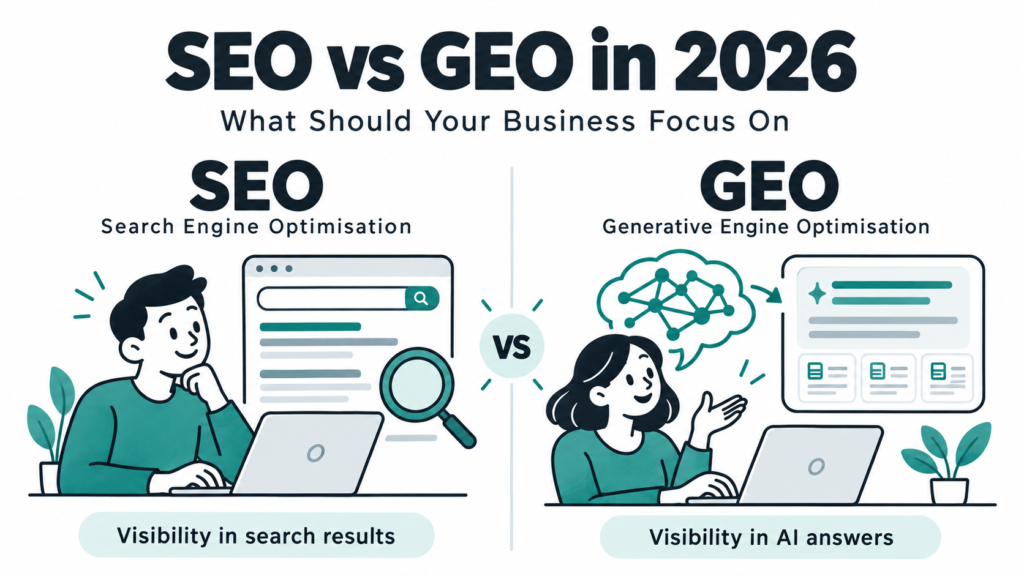
Search engine optimisation, or SEO, helps search engines discover, understand and surface your website for relevant searches. It involves technical accessibility, useful content, internal links and other work that supports organic visibility. A well-built service page should explain your offer clearly and help a prospective customer take the next step.
Generative engine optimisation, or GEO, describes efforts to improve how a business appears in AI-generated responses. That might involve being cited as a source or having your services accurately represented in an answer. Different AI platforms retrieve and present information differently, so visibility is not uniform across them.
The two approaches overlap considerably. Google explicitly says that optimising for its generative AI search experiences remains SEO, with established best practices continuing to matter. GEO is therefore best treated as an additional visibility consideration within your broader strategy. developers.google.com
What Your Business Should Prioritise First
Start with the condition of your website. If important pages are inaccessible, your service descriptions are vague or visitors cannot find essential details, those problems deserve attention first. Investing in SEO services should give you a clear order of work based on your business goals and existing performance.
Next, examine whether your content answers buying questions thoroughly. Imagine a customer comparing website development agencies. They may want to understand maintenance costs, project timelines, ownership and what happens after launch. A page that explains these details gives them more useful information than repeated claims about being the best agency.
Your AI SEO strategy can build on that foundation. Add verifiable examples, explain your process and keep business information consistent. Publish details your team can substantiate, including relevant limitations. These improvements help readers evaluate your business without depending on speculative tricks for securing AI mentions.
How to Balance Your Effort and Measure Progress
Avoid choosing a fixed SEO and GEO budget split simply because it sounds balanced. A newer website may need substantial technical and content work. An established business with useful pages may have more room to investigate how AI systems describe its products and services.
Track organic search performance alongside meaningful outcomes such as qualified enquiries and purchases. Where referral data is available, examine visits from AI platforms separately. You can also periodically test relevant questions across assistants, recording the date, wording and response. Treat these checks as snapshots because answers can vary.
Build your content marketing strategy around customer needs, then use the evidence to decide your next investment. If you need help setting those priorities, contact PropClicks to discuss a practical plan for search and AI visibility.